
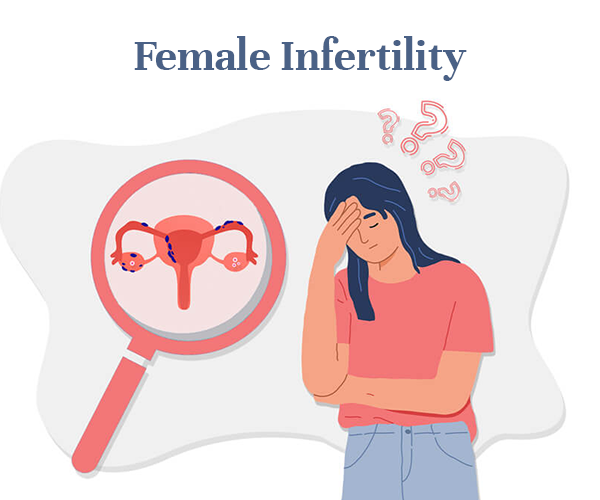
Female Infertility
When you’re having issues conceiving, it can turn an energizing time full of guarantees into an upsetting time filled with questions. Fruitlessness is a challenge you confront if you’re more youthful than 35 and haven’t been able to get pregnant after attempting for one year, if you’re older than 35 and haven’t conceived after more than 6 months if you’ve misplaced two or more pregnancies to premature delivery or you have attempted other ripeness medications without results.
You ought to look for offer assistance sooner if you have unpredictable menstrual cycles or have had gynecological issues such as endometriosis, pelvic surgery, tubal pregnancies, or infections.
There are a few steps in the preparation of getting pregnant, and your body may be having inconveniences with one or more of these steps, including egg generation, fertilization, and implantation.
What Causes Infertility?
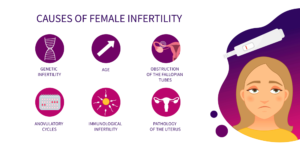
Problems with ovulation are the most common reasons for barrenness in ladies. A woman’s age, hormonal awkward nature, weight, introduction to chemicals or radiation, and cigarette smoking all affect ripeness. Other reasons include:
- Cervical bodily fluid issues.
- Endometriosis.
- Damage to the fallopian tubes.
- Poor nourishment.
- Polycystic ovary disorder.
- Uterine fibroids.
What are the Hazard Components of Infertility?
There are a few common variables that influence your ability to ovulate, conceive or convey a child effectively. These include:
- Anovulatory menstrual cycles: anomalous cycles of shifting degrees, often characterised by the nonappearance of ovulation and/or luteal phases.
- Autoimmune disorders.
- Blood clotting clutters.
- Uterine abandons.
- Blockage of the cervix.
- Eating disarranges.
- Endometriosis.
- Exposure to the sedate diethylstilbestrol (DES).
- Chronic illnesses such as diabetes.
- Pelvic fiery malady (PID).
- Many sexual partners.
- Sexually transmitted maladies.
Diagnosis of Female Infertility
Diagnosis and Evaluation
Diagnostic strategies can recognize the causes of fruitlessness. Some of the time, conclusion can be simple — fair a matter of conducting a few basic tests. Other times, pinpointing the cause requires time and persistence. And, in a few cases, no cause of fruitlessness can be found.
A symptomatic assessment regularly starts with a physical exam and a careful wellbeing history. A while later, the doctor may advance assess utilizing one or more of the taking after methods:
- Confirming ovulation
- Conducting a blood test: A blood test will decide if there is ordinary ovulation physiology. Ovulation brokenness can result from hormonal lacks, innate abandons, and age.
- Assessing ovarian save: A doctor assesses the follicle invigorating hormone (FSH) level. A blood test is performed that can decide the number/quality of eggs remaining in a woman’s ovary.
- Measuring hormone levels: A common cause of barrenness is polycystic ovary disorder (PCOS). This disorder is hereditarily connected to hormonal lopsided characteristics subsequently causing a condition that avoids ovulation.
- Performing a post-coital test: After intercut, the cervical bodily fluid is analyzed to see how well sperm survive in a woman’s regenerative tract.
- Taking a biopsy of the endometrium (lining of the uterus): This test assist examines issues with ovulation or hormones.
Depending on the patient’s condition, extra point by point tests may be performed to decide the cause of the barrenness. Penn Ripeness Care gets it that the handle of conclusion and treatment choice may be candidly requesting and requires the most thoughtful of approaches, with consideration to the passionate needs of the couple.
Treatment at Penn
Hormone Treatment to Actuate Ovulation
Medications may be utilized to initiate ovulation in those who are not ovulating or are ovulating unpredictably. Furthermore, hormone treatment can be utilized to lighten other endocrine (organs that deliver hormones) problems.
The causes of ovulation disappointment are various. The most common cause is polycystic ovary disorder (PCOS). Learn more around Penn Richness Care’s devoted PCOS Center and the amazing victory rates seen at Penn.
In Vitro Fertilisation
In vitro fertilization (IVF) is the favored or most common barrenness treatment utilized when the fallopian tubes are seriously harmed or missing, and for unexplained or male figure fruitlessness. Due to its tall victory rate, IVF has been utilized more as often as possible in later a long time as a to begin with line of treatment for all causes of infertility.
The taking after steps are taken when performing in vitro fertilization:
- The ovaries are fortified to create numerous egg-containing follicles.
- Progression of follicular improvement is taken after by assessing hormone levels and performing ultrasounds at the suitable times.
- A transvaginal ultrasound guides the recovery of the eggs.
- The recouped eggs are promptly exchanged to the research facility where they are refined and fertilized.
- On a foreordained date, the creating preembryos are embedded into the uterus.
These methods include a assortment of carefully choreographed methods to safeguard the best victory. The method itself, counting the research facility work, is performed in Penn Richness Care’s central state-of-the-art facility.
Surgical Options
Surgery is utilized to expel grips (scar tissue) or endometriosis, which square the fallopian tube or meddled with its capacity to choose up an egg. Progressed methods have moved forward our capacity to do this, regularly with a non-invasive laparoscopic approach or with a microsurgical approach to recreate the fallopian tubes or the uterus.
Microsurgical repair is an alternative for turning around tubal sterilization and frequently gives a tall victory rate without the use of in vitro fertilisation. When the fallopian tubes are broadly harmed, or when it is improbable that they will react to surgical treatment, in vitro fertilisation is the most quick approach.
If there is broad tubal harm, the influenced fallopian tube is ordinarily evacuated some time recently continuing to IVF. This makes a difference to accomplish more prominent victory for the IVF strategy. For endometriosis, the laparoscopic approach with laser treatment is regularly effective.
Intrauterine Insemination (IUI)
Ovulation acceptance may be utilized in combination with intrauterine insemination (IUI). IUI is a generally “low-tech” helped regenerative innovation (Craftsmanship) in which washed sperm is stored into the uterus and fallopian tubes, where fertilisation occurs.
In expansion, this handle bypasses threatening cervical bodily fluid and helps in overcoming sperm number and motility issues. Intrauterine insemination was spearheaded by the Penn group and was broadly assessed in a multi-center ponder distributed in the Unused Britain Diary of Medicine.
Egg Donation
In uncommon cases with untimely ovarian disappointment, the ovary is no longer discharging eggs since the supply of eggs has been depleted. In spite of the fact that no treatment is accessible to switch this prepare, it is vital to recognise this condition. A few patients will look for guide and exhortation to adapt with this diagnosis.
When the understanding is incapable to deliver a pregnancy with her claim eggs, the use of giver eggs can be considered as an option.


